AI-generated image by Cosmic Program
Lately, you might have noticed discussions about Pluto entering Aquarius and wondered what it means. It’s true, Pluto has officially moved into the sign Aquarius, a transition that occurs once every ~250 years. The last time this happened was inDecember 1778.From the French and American Revolutions to public persecution, the beheading of elites who famously declared, ‘Let them eat cake,’ and the dawn of the ‘Industrial Revolution’ displacing countless human jobs, this era of history echoes themes astrologers have long associated with Pluto’s transit through Aquarius.
As we move into this new cycle from 2023 to 2043, predictions of societal upheaval, technological revolutions, and the reshaping of power structures are coming to the forefront. For instance, astrologer Bracha Goldsmith, echoing almost every other reputable astrologer, shared public predictions for this era in 2022 that have already been making headlines one after another.
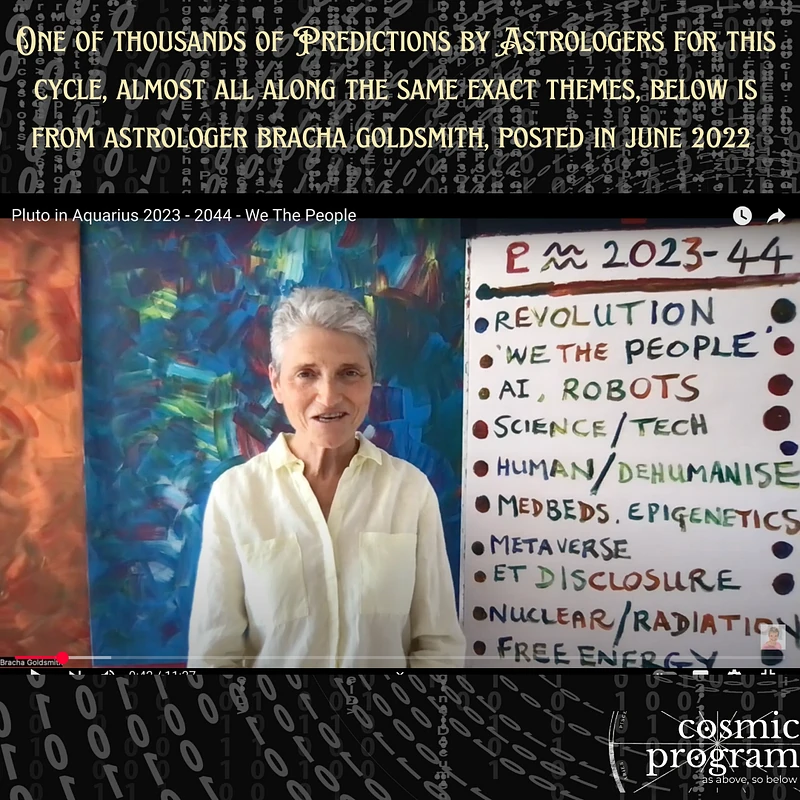
Fig . Astrologer Bracha Goldsmith, one of numerous astrologers who has predicted such themes, similar to others, for the cycle of Pluto in Aquarius (2023–2044). Notably, her list, published in June 2022, has closely mirrored many of the events that have since captured global headlines!
Pluto’s entry into Aquarius signifies transformation, death, and rebirth in all Aquarian themes and archetypes, much like its influence on Capricornian archetypes since 2008. However, this article isn’t about Aquarius or Capricorn or Pluto in these signs, it’s about Pluto. To fully understand the impact of Pluto archetype transiting through any zodiac sign, we must first explore and truly comprehend the essence of Pluto and its profound significance in astronomy, astrology, and mythology.
It must be emphasised that in this article, we continue to present yet another astronomical anomaly, challenging the skepticism of traditional scientists who dismiss ancient sciences such as astrology and label such synchronicities as ‘random’. By examining the rare and profound Pluto-related astrological alignments of the four key figures involved in Pluto’s discovery, naming, and its symbolic ‘death’ as a planet, we demonstrate that the combined probability of these occurrences is approximately one in 10 quintillion, if left to chance alone. These staggering odds underscore the extraordinary synchronicity and deeper symbolism tied to Pluto’s role in history, resonating with its archetypal themes of transformation, power, and profound cosmic connections.
a. The Pluto Archetype/Script
Pluto was first discovered on February 18, 1930, by the young astronomer Clyde Tombaugh. Coincidentally, the timing of its discovery aligned with a world on the brink of massive change: the invention of the atomic bomb.
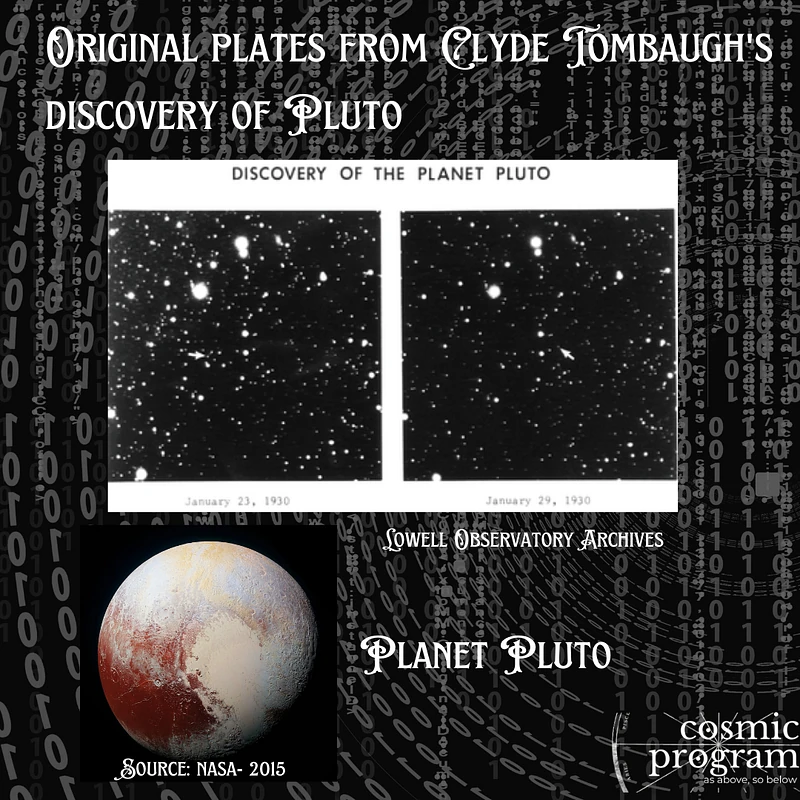
Fig. Top Images: Clyde Tombaugh’s Discovery of Pluto (January 1930); Bottom Image: Pluto Captured by NASA’s New Horizons Spacecraft on July 14, 2015
Indeed, the 1930s marked pivotal advancements in nuclear science. Hungarian-German physicist Leo Szilard first envisioned the concept of a nuclear chain reaction in 1933, while Italian physicist Enrico Fermi unknowingly split neutrons within uranium during his experiments the following year. Austrian-Swedish physicist Lise Meitner, collaborating with German chemist Otto Hahn, successfully achieved uranium fission, naming the process despite being forced to flee Nazi Germany due to antisemitism. By 1939, Szilard, alarmed by the implications of Hahn and Meitner’s discovery, replicated their findings with Walter Zinn and began constructing a nuclear reactor with Fermi, aware that German scientists might be developing similar technology for the Nazi regime.
Recognising the urgency of the situation, Szilard enlisted Albert Einstein to co-sign a letter to President Roosevelt in 1939, warning of Germany’s potential to develop nuclear weapons. This spurred the creation of the Manhattan Project, led byJ. Robert Oppenheimer, which brought together the brightest minds in physics to harness nuclear power. Their efforts culminated in the development of the atomic bomb, forever changing the course of history and warfare. Reflecting on the bomb’s devastating power, Oppenheimer famously quoted the ancient Hindu scripture, the Bhagavad Gita, upon witnessing its power: “I am become Death, the destroyer of worlds.”
This statement reflects Pluto’s essence in astrology, complex power dynamics, birth or rebirth through destruction, and profound transformation that leads to either evolution or devolution!
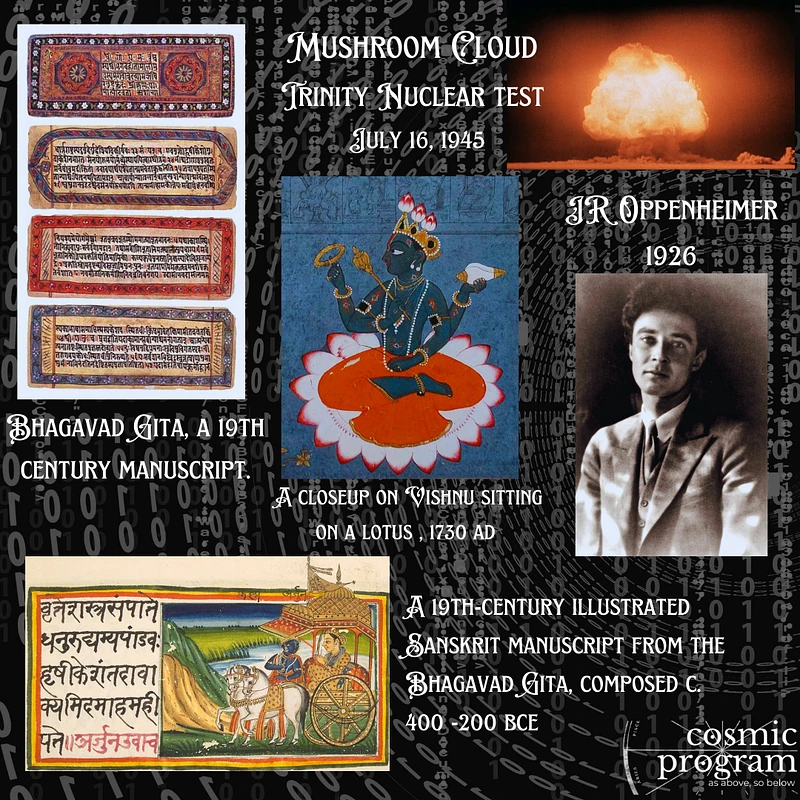
Fig. Various Public Images of J. Robert Oppenheimer, the Trinity Nuclear Test, and the Hindu Scriptures He Studied
The mythology surrounding Pluto is equally rich. Named after the Roman God of the underworld, akin to the Greek Hades, Pluto rules over death, the unseen, and hidden treasures. In the Vedic tradition, deities like Rudra (a fierce form of Shiva) and Kali, with their associations to power and endings, are often seen as symbolically resonant with Pluto’s themes, though not all astrologers within that tradition recognise Pluto as a celestial body.
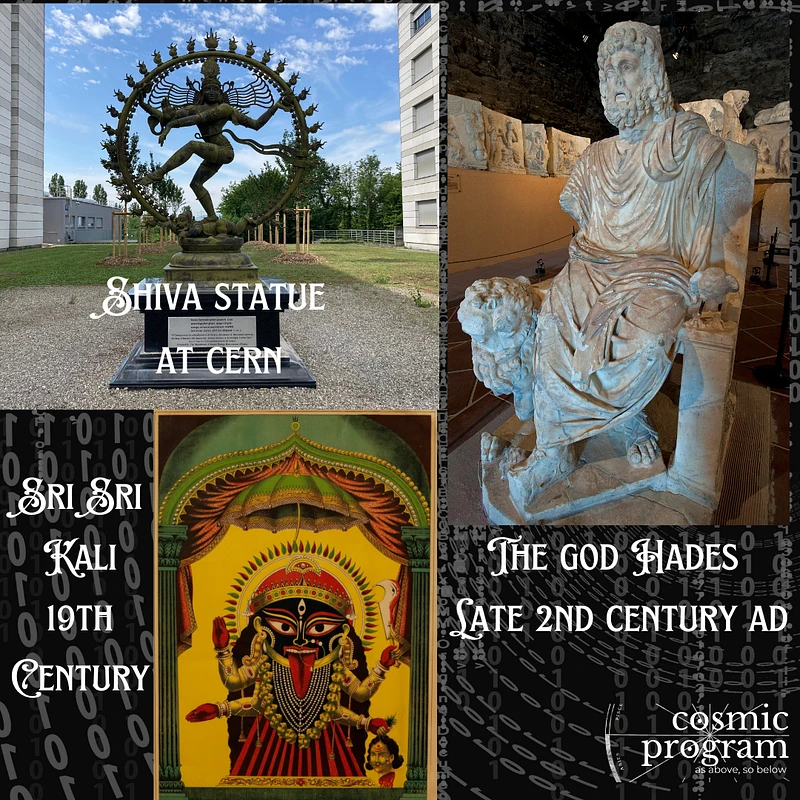
Fig. Various Images Depicting the Similar Archetypes of Pluto (Hades), Kali, and Shiva
In modern astrology, Pluto is considered the ruling planet of Scorpio, traditionally a sign associated with intensity and rebirth. However, ancient systems, such as Vedic astrology, linked Scorpio to Mars and Ketu (the South Node of the Moon), which are often associated with transformative or volatile energies. In my experience, Scorpio’s influence is best understood through a blend of these forces: Pluto, Mars, and Ketu. Together, these planets or ‘scripts’ represent Scorpio’s essence, just as Saturn, Rahu, and Uranus together represent Aquarius, capturing its full spectrum of intensity, insight, and eccentricity.
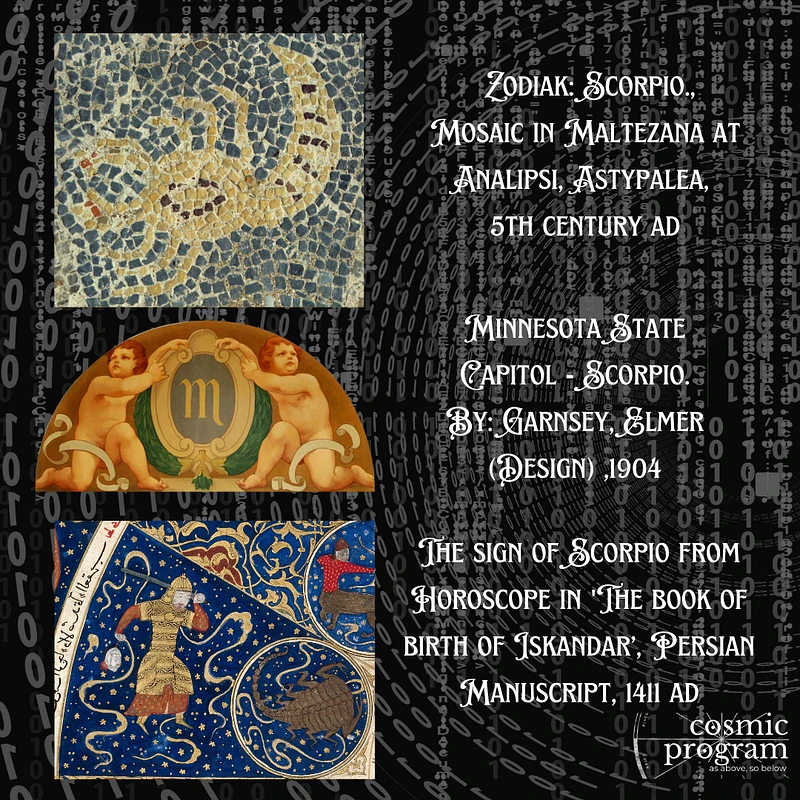
Fig. Ancient Depictions of Plutonic Themes and Their Association with the Sign of Scorpio Across Various Cultures
As discussed extensively in our previous articles, we have concluded that such planetary alignments and synchronicities can only be understood within an “information-processing system” or a “scripted matrix,” where each ‘celestial body, name or concept’ acts as a code that triggers specific outcomes universally.
This implies that our reality might be a simulated framework governed by underlying codes, which align with the “Cosmos Above” through precise mathematical patterns. With over 5,000 years of detailed data on these cosmic alignments, we can access the system’s ‘program manual’ in the form of a multilayered 3D ‘horoscope’, akin a QR Code, and decipher it through the sophisticated language of ‘astrology’ to decode its mechanisms. Essentially, life on Earth appears to be entangled and synchronised at the quantum level with the solar system.
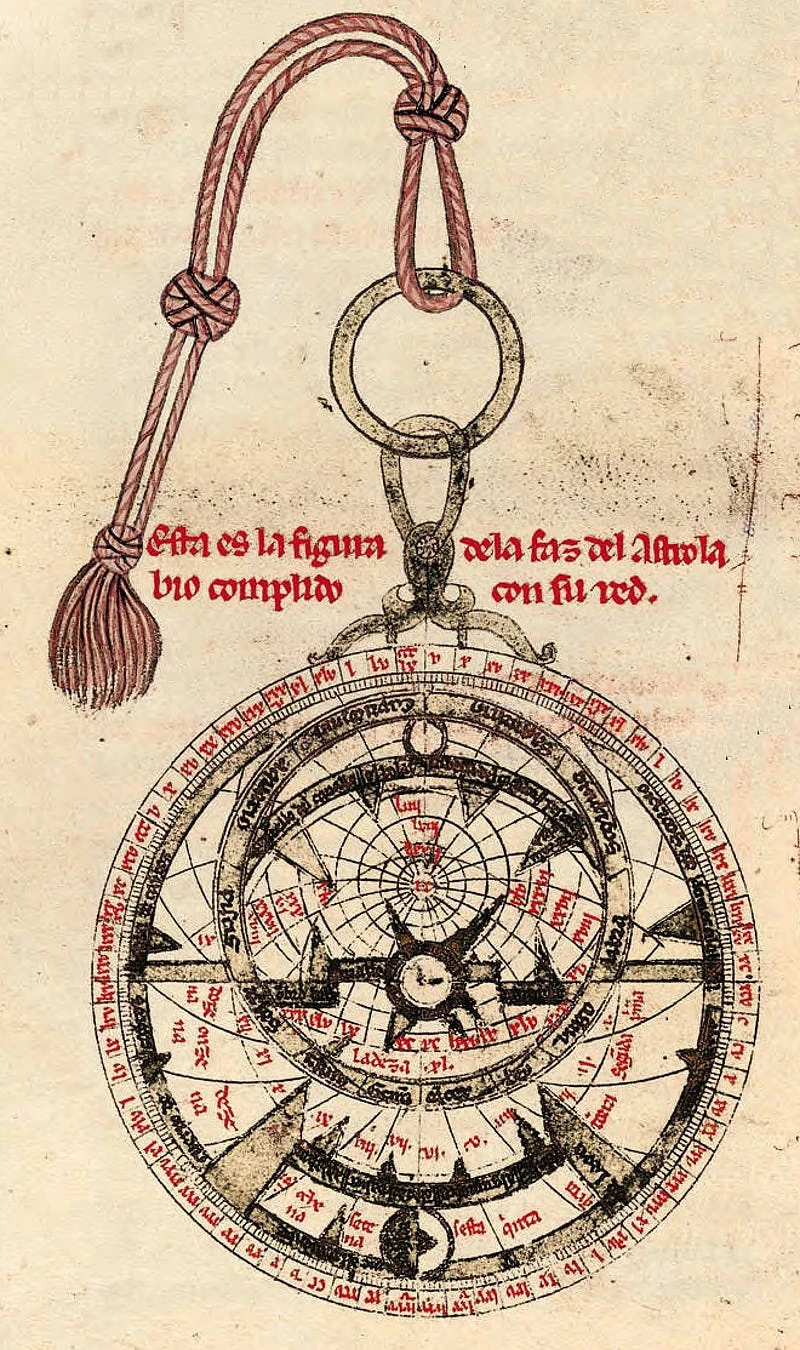
Fig . An astrolabe from “Books of knowledge” ( Un astrolabe du “Libros del saber”) between 1276- 1279 AD. Source: Projet piloté par Alphonse X le Sage, Public domain, via Wikimedia Commons
This raises questions about the nature of the programming language behind this reality, potentially being an advanced “abstract language” beyond conventional computing. We also consider whether the universe functions as a “neural network,” similar to the interconnected nodes in the brain, with the potential for consciousness to influence the simulation through thought.
Regardless of the debate over whether Pluto is a planet or whether any celestial body directly influences events, cause and effect are not crucial when explaining the mechanisms behind astrology or any symbolic holistic science. By applying quantum physics and simulation theory, we can describe everything through correlations with the cosmos, supported by thousands of years of detailed data. We can view Pluto and its complex mathematical aspects as various codes or scripts within a machine-learning framework. This is where many scientists go wrong in their understanding of astrology, spirituality, or so-called ‘pseudoscience’.
b. Astronomy of Pluto
Pluto’s orbit takes approximately ~250 years, spending roughly 21 years in each sign, though this varies due to its elliptical orbit, which is tilted 17 degrees from the main plane of the solar system, a stark deviation compared to Earth’s 1-degree variation.
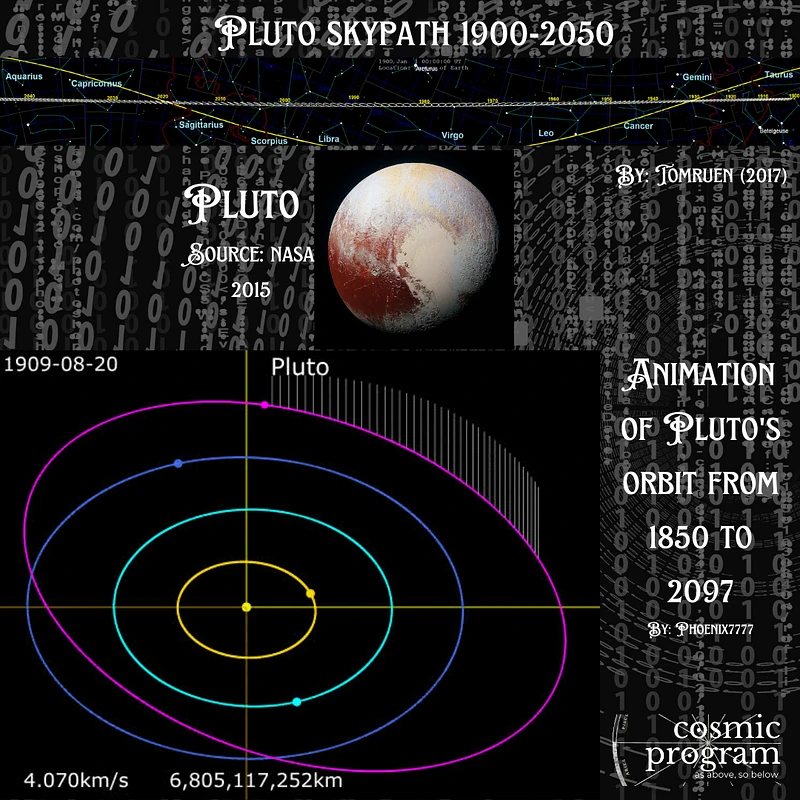
Fig . A Remarkable Fact About Pluto: Its Orbital Path Has an Extreme Tilt of 17 Degrees, Reaching Far Deeper into Our Solar System During Some Transits.
The irregularity of Pluto’s orbit means that it sometimes comes closer to the Sun than Neptune. For instance, in the 20th century, rare Pluto oppositions (to Natal Pluto) occurred, typically only experienced by individuals who lived over a century. However, certain generations encountered this intense transit in their 80s or 90s, a rare cosmic phenomenon influenced by Pluto’s path.
Essentially, this orbital tilt extends Pluto’s transit through Taurus and shortens it in Scorpio. These differing time spans result in varied generational impacts, emphasising Pluto’s transformative energy in some eras more than others. Pluto’s discovery in 1930, for instance, was itself a product of almost a century of searching for “Planet X”, a quest ignited by astronomer Percival Lowell in 1906. Though Lowell died in 1916, some of his images had unknowingly captured Pluto, but it wasn’t officially identified until Tombaugh’s observations.
The naming of Pluto also has an intriguing history, highlighting the planetary body’s broader appeal. After its discovery, Lowell Observatory received thousands of name suggestions, with mythological references predominating. Allegedly, the name “Pluto” came from 11-year-old Venetia Burney, who suggested it to her grandfather, a former Oxford librarian. He passed her suggestion to a friend, an astronomer who relayed it to Lowell Observatory. Surprisingly, Pluto’s name resonated worldwide and was ultimately chosen, forever linking Venetia with this mysterious, far-off world.
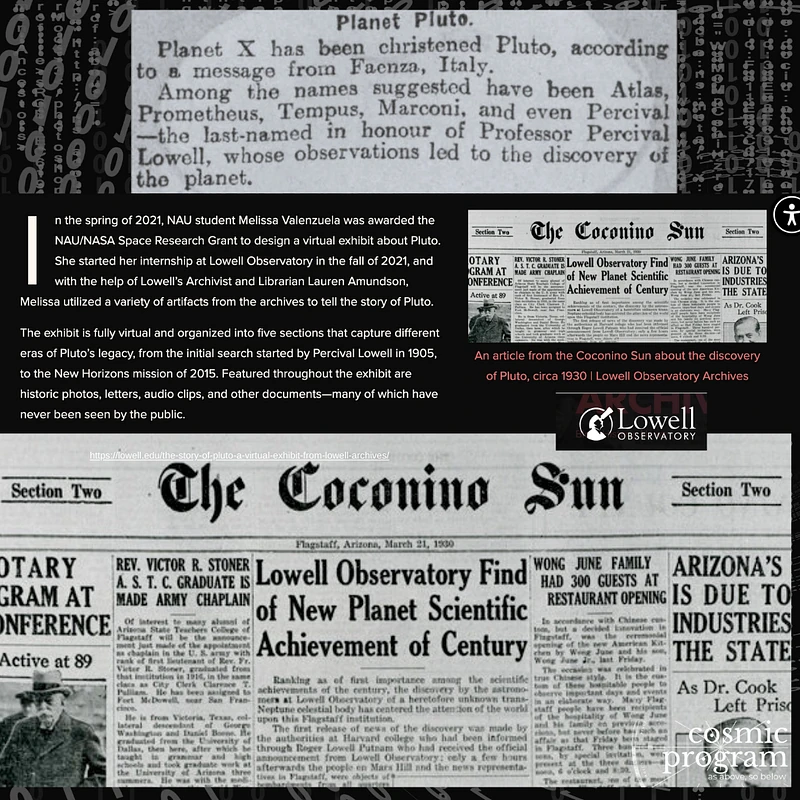
Fig. Headlines from Lowell Observatory’s Discovery of Pluto, with Early References to Planet X, Which Many Assumed Could Be Pluto.
c. Pluto’s Astronomical Synchronicities
Curiously, astrological charts of those involved in Pluto’s discovery reveal intriguing so called**‘coincidences’.** When Venetia Burney suggested Pluto’s name, Pluto was precisely aligned with her Sun, a rare transit that few experience, as it occurs once every ~250 years. Additionally, as if by fate, she passed away at 90, just as Pluto was in direct opposition(180° aspect) to her natal Pluto, underscoring the planet’s lasting influence in her life.
Percival Lowell, the astronomer who tirelessly searched for Pluto, also had the planet aligned prominently in his astrological chart, reflecting a profound, though ultimately posthumous, connection to the planet he was searching for his entire life. Clyde Tombaugh, the young astronomer who finally identified Pluto, had a natal chart featuring a close conjunction between Pluto and his Moon (almost fused to one another), symbolising a deep psychic connection to the planet itself.
Interestingly, the discovery of Pluto itself is entwined with Plutonian themes. When Percival Lowell passed away before his discovery, his widow engaged in legal battles that halted the search for the planet until 1929. These legal conflicts resonate strongly with Pluto’s association with Scorpio and the eighth house, which governs areas like lawsuits, legacies, and inheritance, themes intricately tied to Pluto as ruler of this domain. Even Pluto’s eventual naming honours Lowell’s initials, “PL,” again connecting it with the eighth house’s focus on ‘legacy’. This synchrony between Pluto’s discovery and the archetypes it governs is remarkable and hints at a cosmic entanglement that plays out between the cosmos (above) and human lives (below).
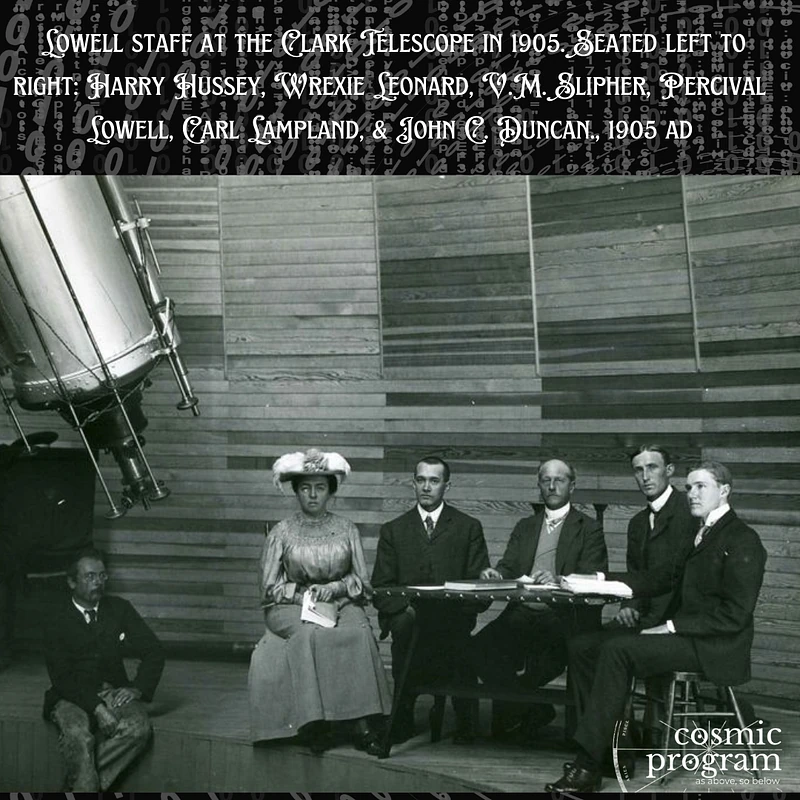
Fig. Some of the Lowell Staff Involved in the Discovery of Pluto (Names Listed at the Top of the Image)
Historically, Pluto itself underwent a type of symbolic “death” when it was stripped of its planetary status by astronomer Mike Brown. Interestingly, this change occurred when Pluto was passing over 26 degrees of Sagittarius, the degree of the ‘Galactic Center’, a supermassive black hole often viewed as the “womb” of the universe, a gateway to origins beyond our known cosmos.
Ancient civilisations, such as the Mayans, even believed that the Galactic Center was the point through which souls entered our universe, while Egyptians held it as the birthplace of the ‘Milky Way’. Pluto’s alignment with this cosmic hub represents its death and rebirth in astronomical terms, echoing its archetypal themes of transformation and renewal. In many ways, Pluto’s symbolic “rebirth” post-demotion seems to have deepened its allure and visibility, gaining an almost mythic resonance in both astronomy and astrology
Pluto’s orbital path is also noteworthy. Unlike other celestial bodies, its highly tilted orbit plunges into the depths of the solar system, penetrating realms unseen by others. This depth and isolation mirror Pluto’s psychological domain: the darkest parts of the psyche, repressed memories, and unconscious fears. Psychologically, accessing these layers is notoriously challenging, often requiring deep introspection or even psychoanalytic techniques. Just as astronomers required advanced technology to locate Pluto, so too do we require profound tools to reach the depths of the psyche. Carl Jung, who had a deep appreciation for astrology and often practiced it, understood this concept well.
d. Pluto’s Mythological Synchronicities
Pluto’s discovery in 1930 by astronomer Clyde Tombaugh was itself cloaked in a sort of cosmic mystery. This “planet X,” the farthest known body in our solar system, had eluded astronomers’ grasp for decades. Designation of Pluto as its final name, chosen from Greek and Roman mythology, is a testament to the uncanny synchronicity between astronomy, mythology, and the unfolding power of the 20th century. Just as Pluto was named, the atomic bomb was coming into existence, a stark symbol of humanity’s newfound ability to harness destructive and transformative power.
In mythology, Pluto (or Hades) ruled the underworld or Tartarus, the shadowy domain where souls journeyed after death, a place of no return and the residence of demons and unseen forces. Pluto’s domain was not only a place of death but also of wealth and hidden riches, for only in the depths of the earth does one uncover precious metals and gems.
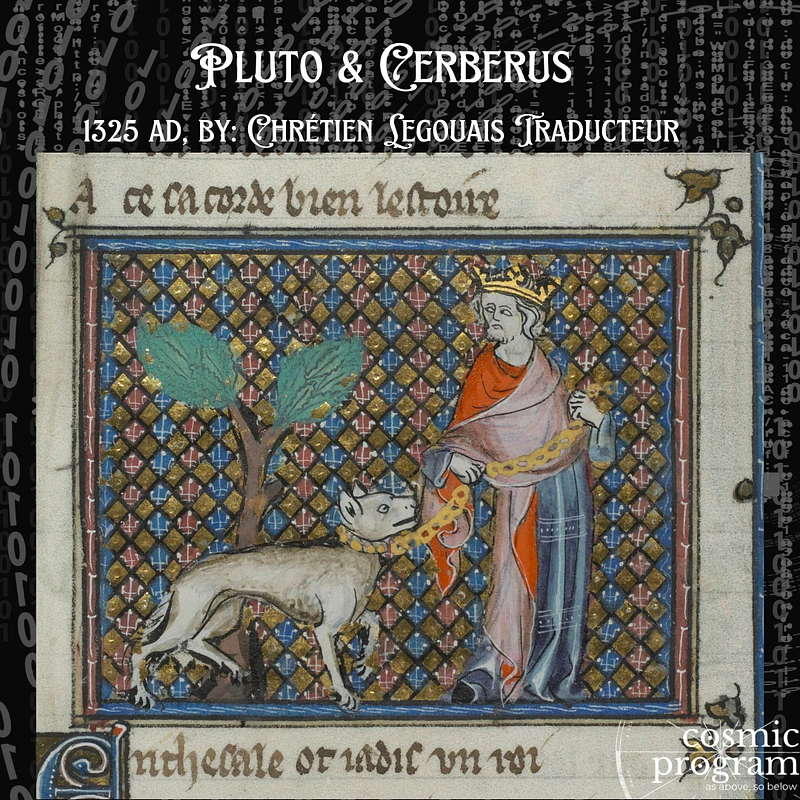
Fig . Pluto & Cerberus (14th Century Image)
The myth of Pluto’s ‘abduction and abuse of Persephone’ reflects this dichotomy between darkness and bounty: after all, Pluto is the ruler of resources hidden in the earth, like treasure or secrets waiting to be unearthed. This is why, astrologically, Pluto governs deep research, mining, and any form of investigation of dark elements, as well as the pursuit of truth, a quality central to detectives, investigators, and even psychologists.
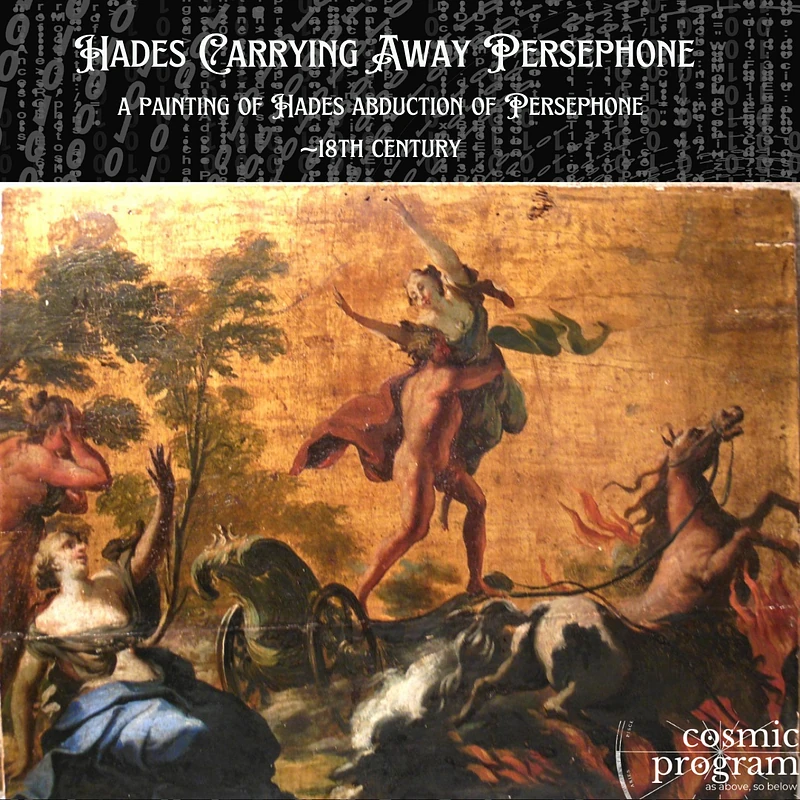
Fig . Hades (Pluto) Carrying Away Persephone (18th Century)
The myth of Pluto’s abduction of Persephone is a haunting story. Pluto kidnaps the young Goddess Persephone, taking her to the underworld. Her mother, Demeter (Ceres), goddess of the harvest and, some say, an embodiment of Gaia herself, plunges into despair, scouring heaven and earth for her lost daughter. This search, full of sorrow and rage, is said to have brought on the harshness of fall and winter. In Pluto’s grip, Persephone symbolised all that was torn away, hidden, and reshaped.
These themes are echoed astrologically: a Pluto transit often brings intense emotions like heartbreak, rage, or even vengeance, and it asks us to search and unearth, often relentlessly, for what has been lost, be it a loved one, a dream, or an unspoken truth.
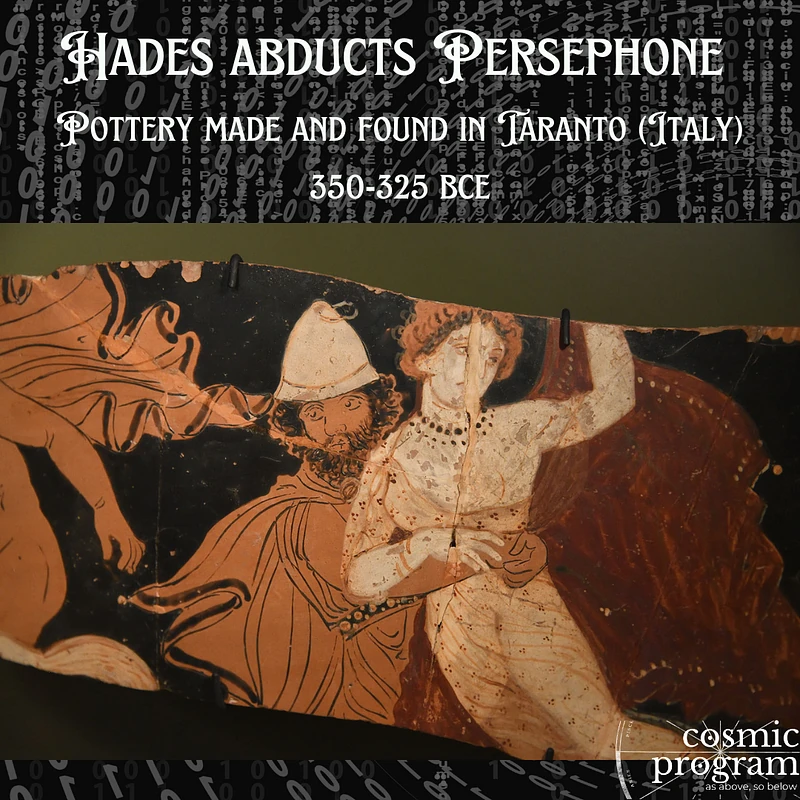
Fig . Hades (Pluto) Abducting Persephone (3rd Century BCE)
When Demeter finally finds Persephone, she discovers a cruel twist: Persephone has eaten pomegranate seeds in the underworld, a symbolic contract binding her to Pluto’s realm. Thus, she must split her time between the world above and the underworld, spending half the year with Pluto and the other half with her mother on earth. This compromise echoes the astrological themes Pluto represents, difficult choices, sacrifices, and the merging of light and dark within ourselves. This tale also reflects the transformative power of Pluto in our lives: once we encounter Pluto’s realm, we do not emerge unchanged. In our lives, Pluto represents contracts, obligations, and the unbreakable binds we form with others, particularly in deeply committed formal partnerships. Pluto’s association with marriage and legal contracts in astrology is rooted in this myth, as well as its ties to Scorpio and the 8th House, the house of hidden power, true wealth, and life-altering bonds.
Persephone’s journey signifies our own seasonal cycles of joy and sorrow, growth and retreat, warmth and chill. When she returns to Demeter, the earth flourishes with spring and summer. But when she descends again to Pluto’s realm, we face the barren cold of fall and winter. This cosmic rhythm mirrors the deep, almost primal urges within us: a pull toward life and light tempered by an unavoidable descent into the darker, hidden corners of our psyche. The sacrifices we make in relationships, careers, and other life contracts echo this Plutonian theme of necessary compromise and transformation. We live through these Plutonian themes of survival, heartbreak, extreme love, or betrayal.
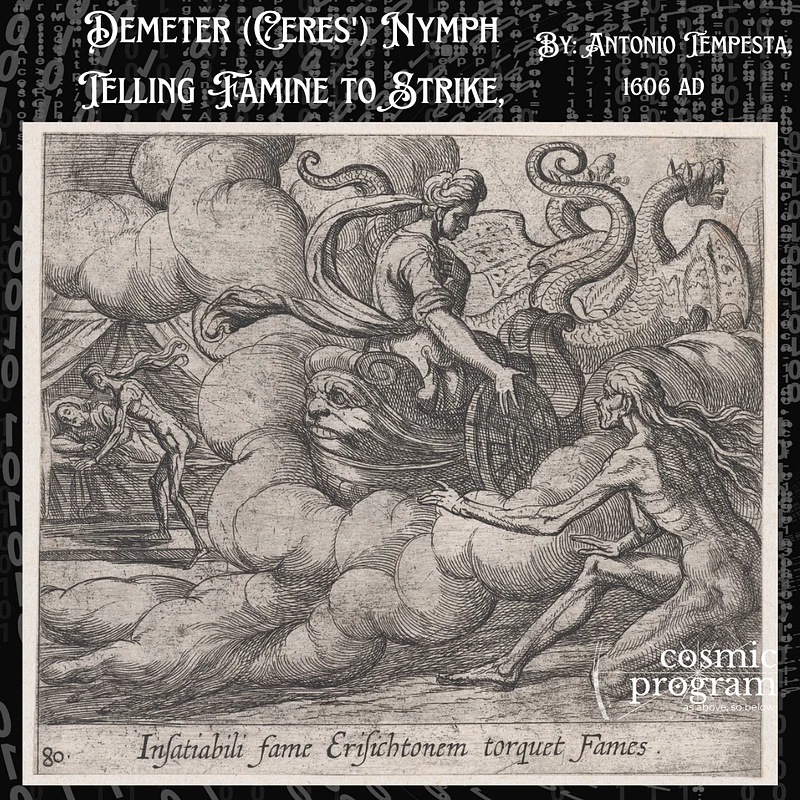
Fig . Ceres (Demeter) Telling Famine to Strike (early 17th Century)
Astrologically, Pluto is revered as the great transformer, and it plays a vital role in karmic and evolutionary astrology. Pluto symbolises our accumulated traumas from past lives, but paradoxically, it also embodies the path to healing these same wounds. This dual nature is one of Pluto’s most profound aspects: it is both poison and antidote. Transits of Pluto, which are slow and last many years, bring forth profound transformation in our lives. These periods often involve significant upheavals, losses, and challenges that seem to “strip away” what no longer serves us, allowing space for “rebirth” and reinvention. Recently, all individuals born under the Capricorn zodiac sign have experienced these themes, including scientists and astronomers who continue to mock Astrology.
Pluto is known to “take away” what is outworn or stagnant. As such, understanding Pluto’s position in a natal chart can provide insights into the areas of life that will undergo radical transformation. Knowing the timing of Pluto transits allows us to anticipate these intense shifts and prepare ourselves, emotionally and psychologically, for the challenges they present. Without knowledge of Pluto’s influence, these periods can feel disorienting, even devastating, but with awareness, they become opportunities for self-mastery and growth.
e. Probability Breakdown
But is it all random, as scientists often claim? Here, we show through math and numbers how astrological assertions, and astrology itself, appear to be anything but random. This time, we illustrate our claims using horoscopes of individuals whose names are linked with Pluto for eternity, as they are forever associated with this celestial body (planet or not).
This is somewhat a quick, glance-level calculation. To fully explore the data, we’d need to account for additional factors, but even within this scope, we’ve included all the essential parameters. The odds remain striking, and while the exact figure might differ with additional variables, the key takeaway is this: statistically, these odds are highly significant, and the inclusion of other factors is likely to further support our claims!
I. Percival Lowell:
To read on Percy’s role and his horoscope analysis by our group, click here.
Condition: Pluto on the Ascendant at birth AND Transiting Pluto conjunct his IC (Imum Coeli) and opposite his natal Moon with a 0° orb
- Pluto’s orbit through the zodiac means it spends ~20 years in each sign. For it to align with the specific degrees of the Ascendant is even rarer!
- Rough estimate: Probability is about 1 in 360 (degree alignment on a 360° chart).
- The IC is a fixed point in the natal chart (exact degree). For transiting Pluto to align within a few degrees (~3° orb) is another 1 in 60 chance (based on 3° radius, ie, 6°/360°).
- A 0° orb opposition between transiting Pluto and natal Moon is extremely precise, making this another 1 in 360 chance.
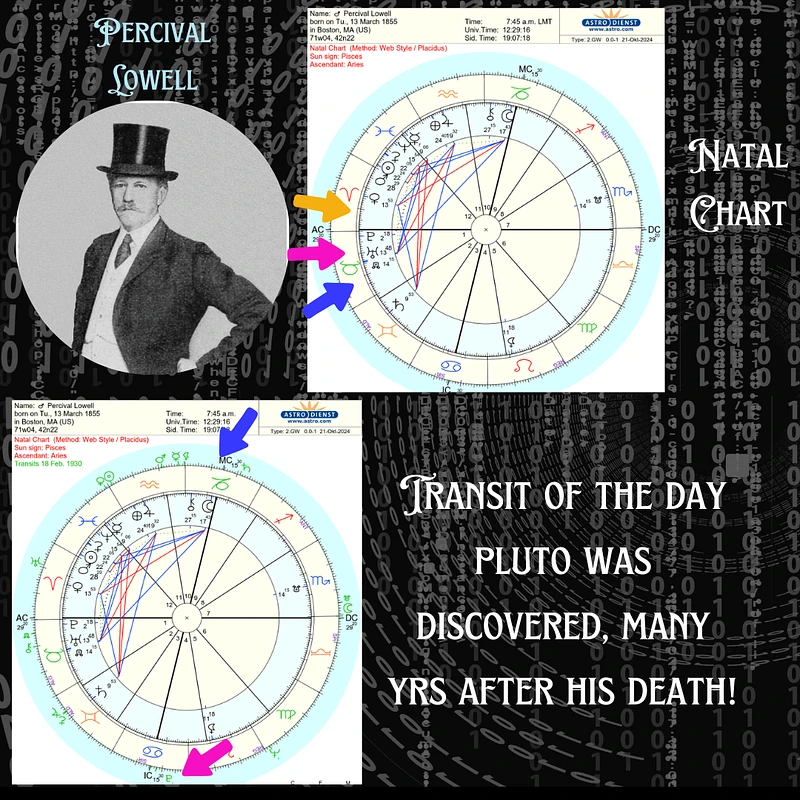
Fig . Percy’s Natal & Transit charts relevant to Discovery of Pluto
Combined Odds for Percy:
To calculate the odds of all three conditions:
Percy Lowell Odds= 1/360 ×1/60 × 1/360= 1/7,776,000
II. Venetia Burney
To read on Venetia’s role and her horoscope analysis by our group, click here.
Condition: Pluto near natal Sun at Birth AND transiting Pluto within 1 deg of natal sun at the time of Pluto’s discovery & naming, AND Pluto Opposition occurring with extremely tight orb at the moment of her death
- Transiting Pluto was within 1° of her natal Sun upon discovery & naming of Pluto. At the time of her death, transiting Pluto was opposite her natal Pluto with a 2° orb
- Probability for Pluto to align closely with the Sun, based on 1° radius, ie, 2°/360° = ~1 in 180.
- The chance of transiting Pluto aligning within 1° of her natal Sun at the precise time of Pluto’s discovery is highly specific: Probability: ~1 in 180.
- Pluto opposition occurs on average once every 120 years, assuming the opposition aligns perfectly at a given time. However, in Cancer-Capricorn axis, Pluto opposition occurs roughly once every ~90 years, making it more likely for someone living to age 90 to experience this alignment. Since she lived to be 90 years old, so her probability of experiencing a Pluto opposition is 100% ( 90/90 = 100%)
- If we restrict the calculation to a narrow orb (e.g., ±2°) for considertaion of the tight orb, the odds decrease significantly. For simplicity, let’s assume that the tight orb reduces the likelihood by approximately 1/10, making the adjusted odds: 100% × 1/10= 10%
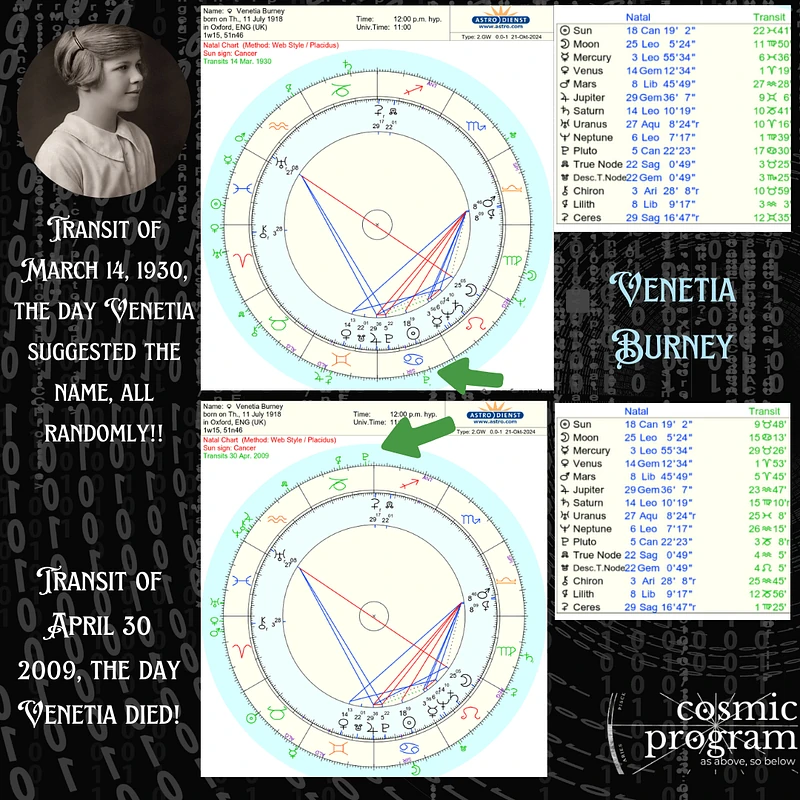
Fig . Venetia’s Natal & Transit charts relevant to Discovery of Pluto & more
Combined Odds for Venetia:
Odds= 1/180 ×1/180 × 1/10= 1/324,000
III. Clyde Tombaugh:
To read on Clyde’s role and his horoscope analysis by our group, click here.
Condition: Natal Moon Conjuct Natal Pluto exactly. Due to missing time of birth, we know he probably has major glyph points (AC/DC/MC/IC) associated with transiting Pluto given pivotal role in this incredible discovery, however, without accurate time of birth, we cannot speculate and include guesswork.
- In Clyde Tombaugh’s natal chart, his Moon and Pluto were in a 0° conjunction (exact orb).
- Without an exact birth time, we cannot determine the specific house placements or Ascendant-related influences of transiting Pluto in 1930. However, we can still consider the general impact of his Moon-Pluto conjunction. We could add a few other synchronicities that may be relevant, however, we would like to abide by scientific objectivity and remain on the more conservative side. These odds are already science defying as is.
- The Moon moves quickly through the zodiac, taking ~2.5 days to traverse a single sign.
- Pluto’s slow orbit (~248 years per cycle) means that its presence in a specific degree is rare. For a 0° conjunction:
- Probability: ~1 in 360 (exact degree alignment within a 360° chart).
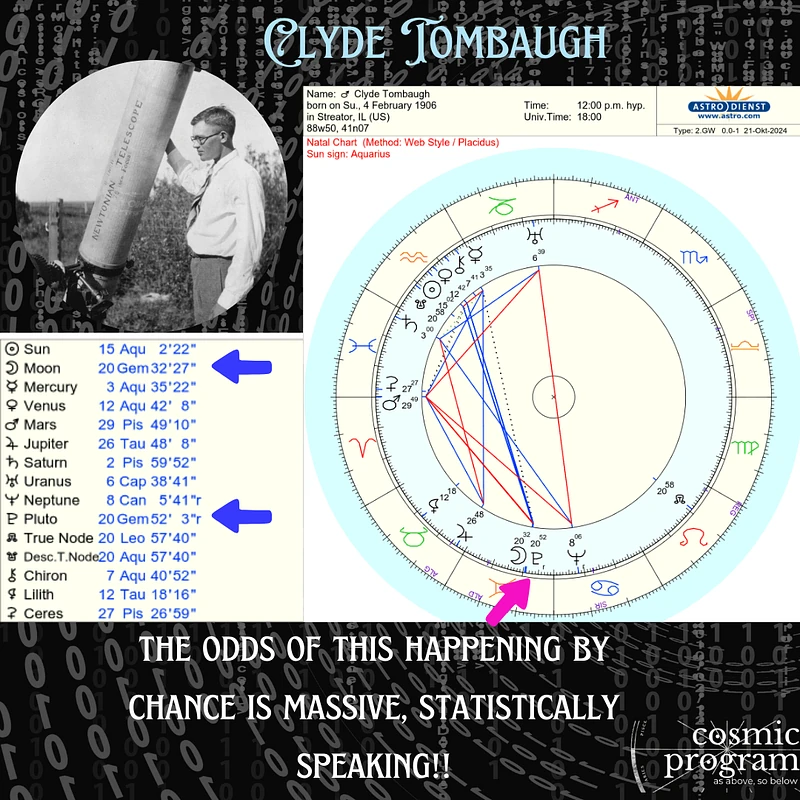
Fig . Clyde’s Natal chart relevant to Discovery of Pluto (There is no known birth time available for him)
Combined Odds for Clyde:
Probability of Natal Moon-Pluto Conjunction= 1/360
IV. Mike Brown:
To read on Mike’s role and his horoscope analysis by our group, click here.
Condition: Stellium involving Pluto and other planets AND opposition with tight orb to this stellium from slow planet of Saturn AND Square aspect to this stellium and Saturn by another stellium involving the sun and destiny point AND during ‘killing of Pluto’, transiting pluto was in hard aspect to all these stellium and to Saturn.
- Natal Pluto in Stellium with Moon, Uranus, and Mars in Virgo:
- Stelliums are rare; the probability of multiple planets (Pluto, Moon, Uranus, Mars) aligning within a few (say 2°) degrees in one sign is approximately 1/ (2*d /360 ^ (n-1)), so for d = 2 and n = 4, probability is 1/11,664,000. Given stellium relative to pluto, the ways we can choose 3 from the remaining 6 planets in our solar system is: 6C3 = 20, so, the overall probability is 1/583,200
- Opposition of the Stellium to Saturn in Pisces with a Tight Orb:
- Adding an opposition with a tight orb to the stellium decreases odds further: 20/360 = 1/18 (based on opposition range of ±10°).
- Square Aspect to Stellium in Gemini (Sun, Rahu, Jupiter, Mercury):
- Including another tight square (±10°) adds a probability of 20/360 = 1/18.
- Transiting Pluto Aspects During the “Killing” of Pluto (2006):
- Pluto in hard aspect (square/opposition) to natal Stelliums and Saturn: 6/360 = 1/60 assuming ±3° for precise alignment).
- Transiting Pluto is on the Galactic Center (GC) after ~ 250 years when Pluto’s death or demotion occurs. Last time Pluto was in this part of cosmos, it wasn’t even discovered. Galactic Center marks the rotational center of the Milky Way galaxy and contains a supermassive black hole known as Sagittarius A. Astrologically, GC symbolises a point of immense gravitational pull, where things are drawn in, stripped of their form, and transformed, or seemingly vanish into a void. Interestingly, Pluto, experienced its ‘demotion’ or ‘death’ from planetary status around this transit. It’s as if Pluto’s symbolic nature played out cosmically as it crossed the Galactic Center, not because of Mike Brown (though someone should let him know). For the purpose of this exercise, we didn’t even include this odd in our calculations, but Mike Brown may want to, the odds are staggering as is.
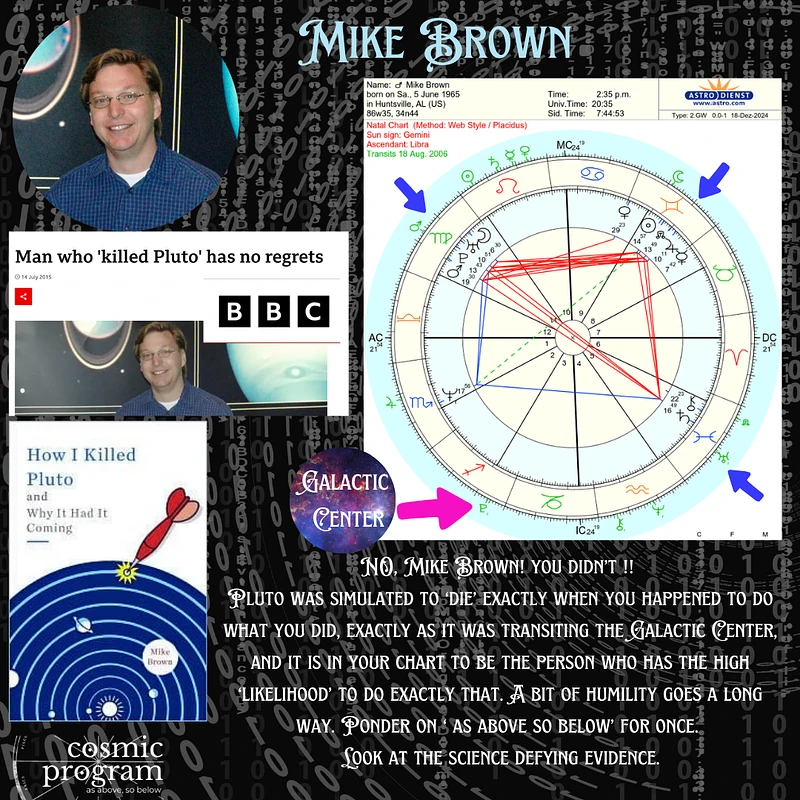
Fig . Astronomer Mike Brown’s Natal & Transit charts relevant to Death of Pluto
Combined Odds for Mike Brown:
Mike Brown’s Odds=1/583,200 ×1/18×1/18×1/60= 1/11,337,408,000
f. Combined Odds in All Four Charts:
**Combined Odds=**1 in 1.028295e+25 (10 quintillion)
1 / 7,776,000 * 1 / 324,000 * 1 / 360 * 1 / 11,337,408,000= 1 / 1.028295e+25
The combined odds of these four individuals having such rare and profound Pluto-related astrological alignments is approximately one in 10 quintillion. These numbers highlight the extraordinary synchronicity and symbolism associated with Pluto’s discovery, naming, and its archetypal influence throughout history.
Curious about Pluto’s placement in your horoscope? Unlock hours of detailed, personalised analysis exploring Pluto’s archetype (among all the others) and its deep impact on your life. Dive even deeper into your cosmic program by ordering your audiobook analysis here: https://cosmicprogram.com/shop
If you’d like to explore this topic further, check out our in-depth coverage and much more on our YouTube channel here:
BY: Gaia & Eion, from Cosmic Program
To our readers: Crafting these articles is a time-intensive endeavour. We are employed full-time scientists with busy lives, plus, we never do things half way. Regrettably, for reasons you’re all aware of, it’s impossible to publish our work in scientific or mainstream journals or mainstream media to reach a broader audience. We encourage you to engage in the comments, on our website, etc; responding to inquiries is a personal religion of ours.
We’ d appreciate if you share our articles. We don’t have a strong online presence, being self-proclaimed “NERDS” with limited social connections, and as explained previously, we’re unable to share our work even within our own community of scientific colleagues and connections.
We are also for the most part ignored and /or snubbed by the establishment of the astrological and divination communities so in our UNIQUE QUALITY work & all our contributions, WE ARE ALL ALONE.
Please bookmark our website and also follow us on on youtube & other social media. As perfectionists, we take an objective, detail-oriented approach to our work, aiming to engage an educated and discerning audience.
If you’re tired of the flood of low-quality, fake AI-generated content, you’ll appreciate the exceptional standard of what we produce, which prioritises the integration of genuine ancient artwork and texts into our creations.
There is absolutely nothing like Cosmic Program products out in the market and certainly, for prices that we offer. All analysis of birthchart audiobooks are written and recorded by myself and unlike many products out there, we have NOT used AI in any of our horoscope analysis or Audio recordings. Sabian Symbol images are generated via AI.
All readings are as scientific, and as comprehensive as our articles. If you are interested in an ‘example’ of our readings and what you will get, please login to listen here. You must login in order to access all readings and free content, including example readings.
References
1- Ephemeris of Year 1778: https://www.astro.com/swisseph/ae/1700/ae_1778.pdf
2- Astrologer Bracha Goldsmith & her predictions for cycle of Pluto in Aquarius from 2023–2044