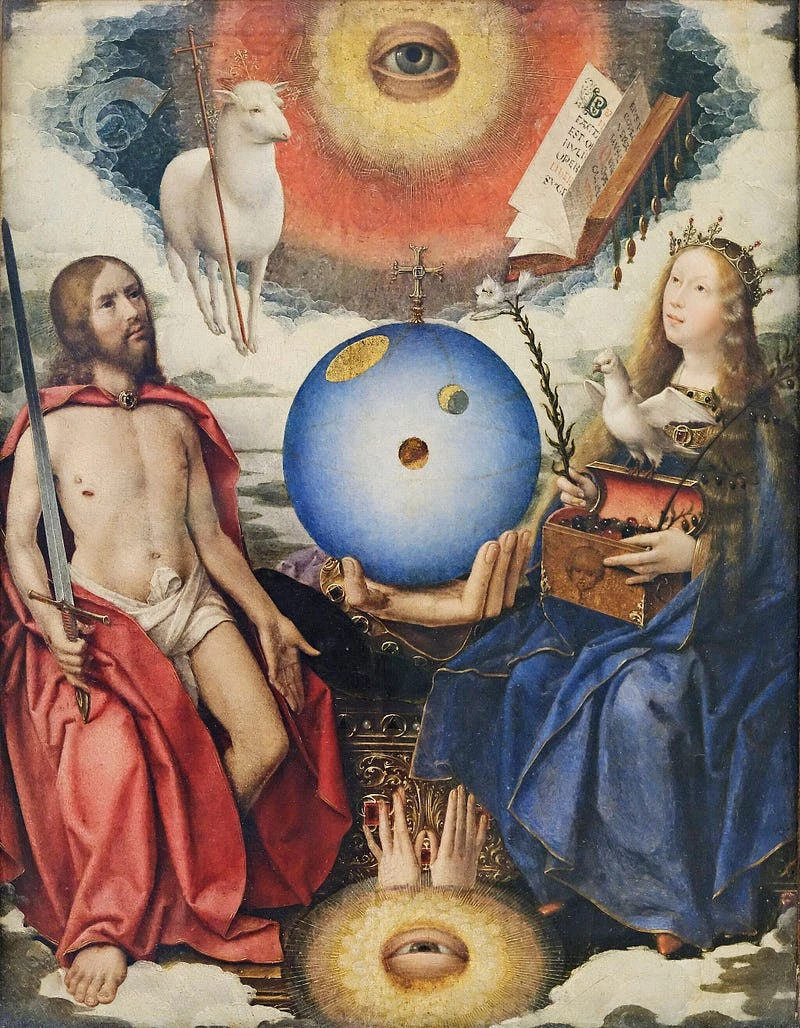
The Cosmos under the eye of God, in the presence of Christ the judge and the Church, Jan Provoost, 1510s AD. Louvre Museum (French Title: Le Cosmos sous l’oeil de Dieu, en présence du Christ-juge et de l’Église, Jan Provoost, 1510s AD., Musée du Louvre). Source: Wikimedia
Following the structure of our earlier research articles, including those on the 2024 election of Donald Trump, the September 11 attacks, the COVID-19 pandemic, the recent Israel–Palestine conflicts, and Oppenheimer’s role in the development of the atomic bomb, this study turns to a different category of inquiry: the cosmic alignments associated with the Crucifixion of Christ. As with other historical events of singular magnitude, such as the fall of Rome or the assassination of Julius Caesar, the Crucifixion provides a rare fixed point in time against which both astronomical configurations and symbolic data can be rigorously examined.
Our aim is to investigate whether an event of this scale leaves discernible, measurable signatures in celestial geometry, and whether symbols obtained through remote viewing exhibit non-random statistical correlations with those alignments. While astrology, as an archetypal and symbolic language, cannot produce deterministic forecasts, it does offer a structured framework for interpreting cosmic patterns and their potential resonance with transformative moments in human history.
Because every cosmic snapshot is effectively unique across cycles of roughly 25,000 years, establishing true statistical significance requires comprehensive comparative modelling, ideally using millennia-scale datasets and computational resources capable of testing, correlating, and filtering complex astronomical patterns with minimal noise. Only under such conditions can we assess whether the correspondences we observe reflect genuine signal rather than coincidence.
At Cosmic Program, we have further theorised that every horoscope functions as a kind of cosmic “QR code”, a compressed informational blueprint encoding the default script of any birth event, whether human, animal, or historical, inside a larger computational matrix we call the universe or reality. If everything is ultimately data, then celestial geometry becomes a readable interface rather than background scenery.
Physicist Carl Friedrich von Weizsäcker, through his Ur-Theory, proposed that the universe is built from binary choices, primordial information units (“urs”) from which all physical structures arise. Konrad Zuse, the father of modern computing, extended this by suggesting that the cosmos is a vast cellular automaton governed by discrete computational rules. Similarly, Edward Fredkin’s digital physics frames reality itself as a computational process in which physical events emerge from underlying informational operations.
Stephen Wolfram demonstrated that simple computational rules can generate complex, lifelike structures, offering a model in which celestial geometry might be read as an interface to deeper informational laws. Seth Lloyd, working in quantum information theory, argues that the universe functions as a quantum computer, performing an enormous number of informational operations since the Big Bang, a view compatible with our model of the human brain as a miniature quantum-adaptive processor tapping into this informational field. Finally, Max Tegmark’s Mathematical Universe Hypothesis posits that reality is a mathematical structure, which supports the idea that cosmic alignments reflect coordinates within a synchronised, self-consistent informational architecture.
After these more expansive computational and mathematical models, John Wheeler’s It-from-Bit hypothesis offers a modest but foundational precursor: the idea that information lies at the base of physical phenomena. While Wheeler did not argue for a literal simulation or computational universe, his insight opened the conceptual doorway that later physicists pushed further.
In contemporary philosophy, Nick Bostrom’s simulation argument proposes that advanced civilisations could generate realities indistinguishable from their own, a view that has become culturally widespread, even echoed by Elon Musk, who has remarked that the odds we are not in a simulation are “one in billions.” Theoretical physicist Leonard Susskind, through holographic principles, further reinforces the idea of a universe encoded on informational boundaries. And outside strict physics, Rupert Sheldrake’s concept of morphic fields proposes nonlocal informational patterns that guide form and behaviour, an idea compatible with symbolic resonance and remote viewing.
Remote-viewing, intuition, symbolic pattern recognition, and archetypal resonance can be understood as cognitive methods for accessing or decoding this structured informational field. In this sense, each cosmic configuration operates like a QR code: a compressed geometric blueprint containing activation potentials that correspond to particular manifestations, trajectories, or symbolic “scripts” within the unfolding game-like architecture of reality.
Such a model only becomes coherent if we assume that we inhabit a mathematically structured, synchronised, and entangled system. The precise geometry of the Solar System serves as both a timing mechanism and a coordinate grid for this informational substrate, enabling, at least theoretically, and via correlated data, the tracking and interpretation of correlations across thousands of years of recorded human observation.
Each cosmic configuration, like a QR code, carries activation potentials, patterns correlating with the emergence and evolution of events within a mathematically governed, synchronised matrix of reality. In this framework, the human brain operates as a quantum‑adaptive processor capable of interfacing with an underlying informational field long described as the aether. From a digital‑physics perspective, the universe itself functions as a computational process, executing informational operations akin to a quantum computer. The consistent symbolic patterns observed across cultures and epochs, including those preserved in astrological systems, may therefore reflect a deeper computational order: a universal algorithm encoded into the architecture of the cosmos and accessible to conscious systems capable of decoding it
Symbolic & Statistical Analysis of Christ’s Crucifixion’s Horoscope:
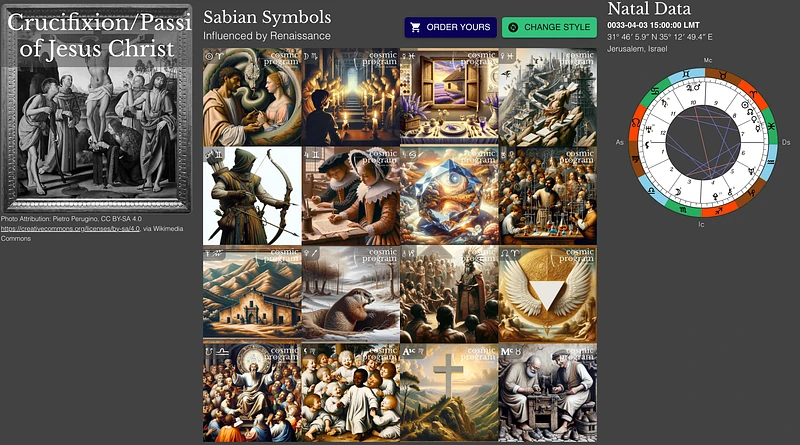
Fig 1. Collection of AI-generated Sabian symbols by Cosmic Program, based on the widely accepted historical consensus for the date and time of the Crucifixion of Christ (April 3, 33 AD, 3 PM, Jerusalem). See the main text below as well as the ‘about’ section from our archive for a detailed explanation of our choice of this date and time.
The crucifixion of Christ is regarded by historians as one of the best-supported events in the historical record of His life. Scholars, including secular historians, New Testament specialists, and classicists, nearly universally accept that Jesus was executed by Roman authority in 1st-century Judaea. While debates continue over the exact details, the precise date, the sequence of events, and the historical accuracy of gospel accounts, the fact of the crucifixion itself is uncontested. The 1st-century Roman historian Tacitus records that ‘Christus… suffered the extreme penalty during the reign of Tiberius at the hands of Pontius Pilate,’ and the Jewish historian Josephus likewise describes Jesus as having been condemned to crucifixion. These references, combined with early Christian writings, firmly anchor the event in history.
According to canonical texts, Jesus was arrested by the Sanhedrin, tried, scourged, and ultimately crucified between two thieves at Golgotha, likely on a Friday near Passover. Time references in the gospels (the “third hour” for crucifixion, death by the “ninth hour”) reflect ancient approximations of hours rather than precise timekeeping. Scholars generally estimate that the crucifixion occurred most plausibly in either AD 30 or AD 33, on a Friday that coincided with Passover, during the governorship of Pontius Pilate.
While exact hours and details cannot be claimed with certainty, these constraints provide a historically informed framework for symbolic analysis, including the study of planetary archetypes and Sabian Symbols. Considering reality as a simulated or informational construct, each human brain, functioning as a miniature quantum-adaptive processor, interacts with the underlying probabilistic substrate. When a sufficient number of minds converge on a shared belief or narrative, their ‘collective measurements’ can amplify specific potentialities in the matrix, effectively rendering that outcome experientially real.
In quantum‑informational terms, this resembles how observation collapses probabilistic states: coordinated attention by conscious observers may synchronise with a particular branch of the informational field, activating the scripts associated with the shared belief and thereby manifesting it within perceived reality.
Regardless, we had ChatGPT analyse the historical claims, with the results presented in the appendix of this article. Interestingly, ChatGPT’s top-ranked crucifixion data coincides with the date and time we selected for our analysis.
Remote-viewing and the Scientific Framing of Sabian Symbols:
The Sabian Symbols, a set of 360 symbolic images and/or messages, one for each degree of the zodiac, were originally developed through the intuitive work of medium Elsie Wheeler, under the guidance of Marc Edmund Jones, a PhD in Philosophy from Columbia University who was trained in scientific methodology. Their development followed a double-blind, qualitative scientific methodology, ensuring rigour in the symbolic associations.
Although the creation of the Sabian Symbols has never been formally classified as remote viewing, the process unmistakably resembles a structured form of psychical intuition or divinatory perception. It involved controlled conditions, a neutral observer, an experienced intuitive, and precise astronomical reference points, producing symbolic impressions for each degree of the zodiac. In many respects, it functioned as an early analog to modern remote-perception protocols, aiming to access archetypal information beyond ordinary sensory input.
Modern research into remote-viewing, including CIA-funded experiments on intuitive observation, has demonstrated the possibility of accessing subtle archetypal patterns. While remote viewing remains scientifically controversial, along the lines of astrology and other para‑ or metaphysical phenomena, multiple controlled experiments, including those conducted at SRI and later evaluated in the U.S. government’s Stargate Program, have produced statistically significant results suggesting that some form of anomalous information access may occur under blinded conditions.
A 2023 meta-analysis of remote viewing studies from 1974–2022 reviewed 36 peer-reviewed experiments. It found a moderate, statistically significant effect size (mean d ≈ 0.34), indicating results above chance. No evidence of publication bias was detected, and success rates remained consistent over time. The authors conclude that remote viewing is the most robust and replicable experimental method for investigating extrasensory perception (ESP) phenomena.
Despite these findings, research in this area has long been affected by institutional bias, selective reporting, and disinformation, particularly surrounding programs like the U.S. Stargate Project. Several favourable operational results were downplayed or omitted in official reviews, shaping a public narrative that the program “failed” despite decades of mixed but often positive data. Such framing reflects a broader cultural resistance to phenomena that challenge prevailing scientific assumptions, often leading to the premature dismissal of research into consciousness, intuition, and anomalous perception, a bias that, sadly, has been endured for centuries by the astrology community and other similar fields.
This pattern continues in the public arena, as seen in the 2025 documentary The Age of Disclosure, which presents testimonies from retired generals, U.S. senators, intelligence officials, and professors regarding long-suppressed evidence of non-human intelligence. Despite the credibility of these voices, many skeptics, including mainstream commentators such as leading anti-astrology provocateurs, for example, Michael Shermer, have mocked or dismissed these claims, demonstrating the persistent bias and reflexive skepticism that often meets reports of unexplained phenomena, even when presented by respected authorities. Together, these examples illustrate the challenges faced by researchers exploring controversial or paradigm-challenging subjects, where credible evidence can be marginalised or ridiculed before it is rigorously examined.
At Cosmic Program, we continue to test the remotely-viewed Sabian Symbols systematically, finding recurring correlations with historical events, key figures, and moments of cultural significance. These patterns are not deterministic proofs, but they offer a statistically and symbolically compelling lens to warrant continued investigation into non‑ordinary modes of perception.
Sabian Symbols of the Crucifixion Chart: The 16-Point Archetypal Cluster
The symbols associated with the major planetary placements and points in the horoscope for the moment of Christ’s crucifixion are presented in the following figures (Figures 2–5) and table 1:
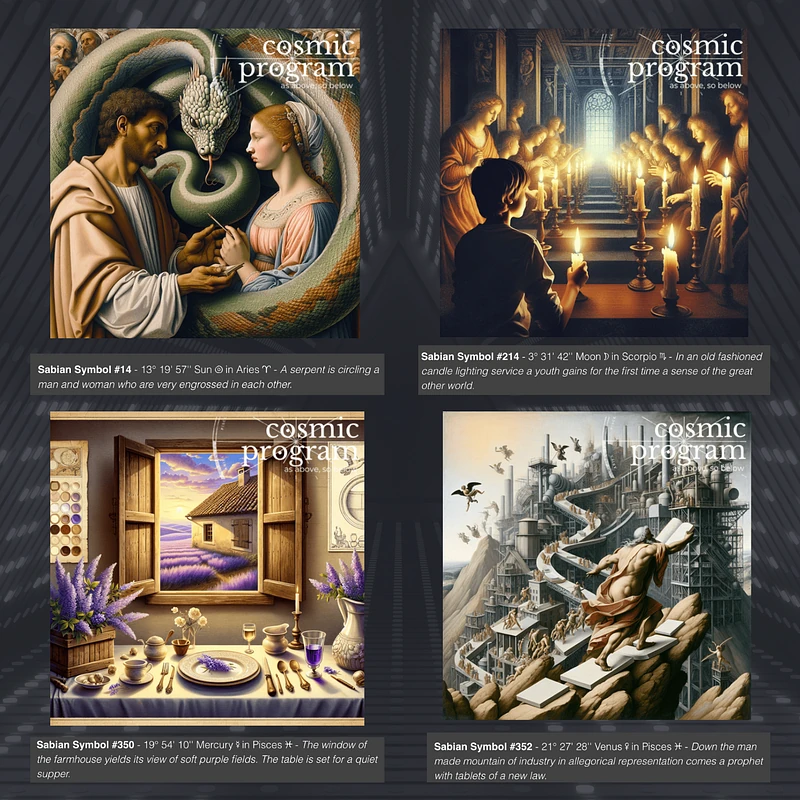
Fig 2. The collection of AI-generated images by Cosmic Program corresponding to the Sabian Symbols for the exact zodiacal degrees associated with the Sun, Moon, Mercury & Venus of the crucifixion horoscope. Refer to the text below each image and the collection in Fig 1 & the link for further analysis.
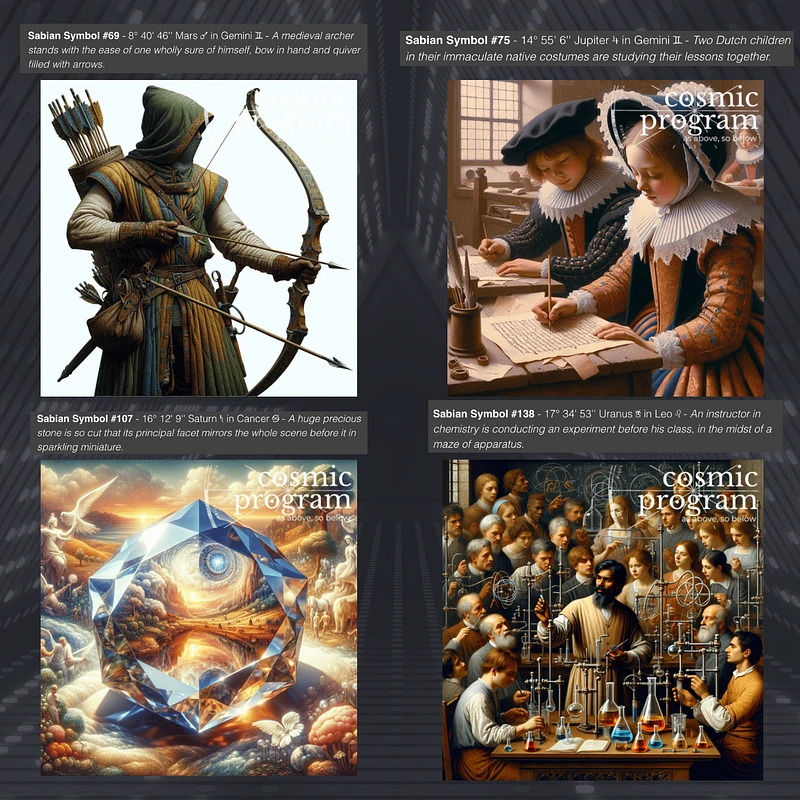
Fig 3. The collection of AI-generated images by Cosmic Program corresponding to the Sabian Symbols for the exact zodiacal degrees associated with the Mars, Jupiter, Saturn & Uranus of the crucifixion horoscope. Refer to the text above each image and the collection in Fig 1 & the link for further analysis.
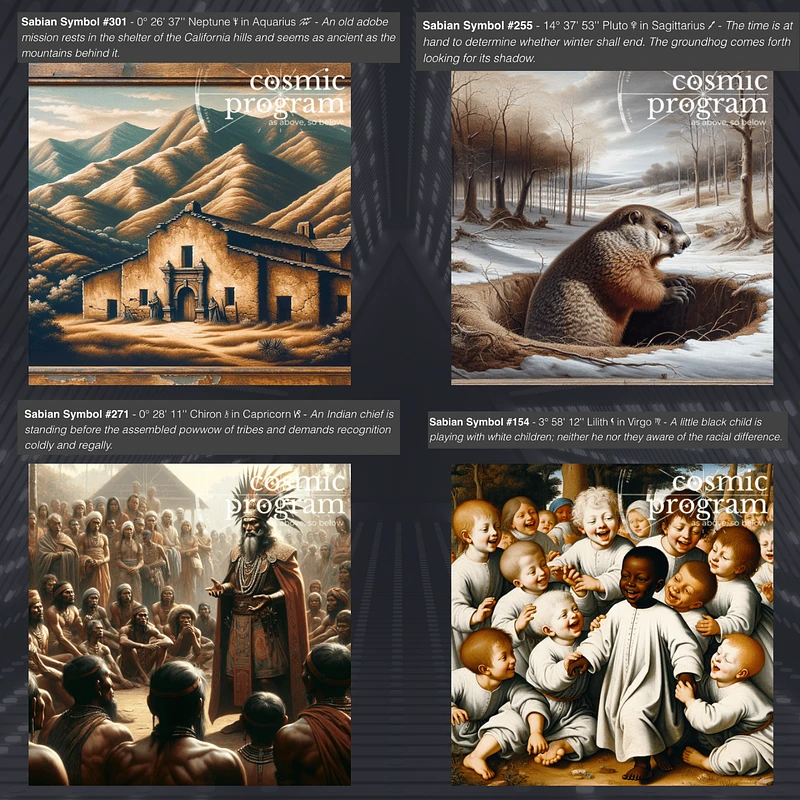
Fig 4. The collection of AI-generated images by Cosmic Program corresponding to the Sabian Symbols for the exact zodiacal degrees associated with the Neptune, Pluto, Chiron & Lilith of the crucifixion horoscope. Refer to the text above each image and the collection in Fig 1 & the link for further analysis.
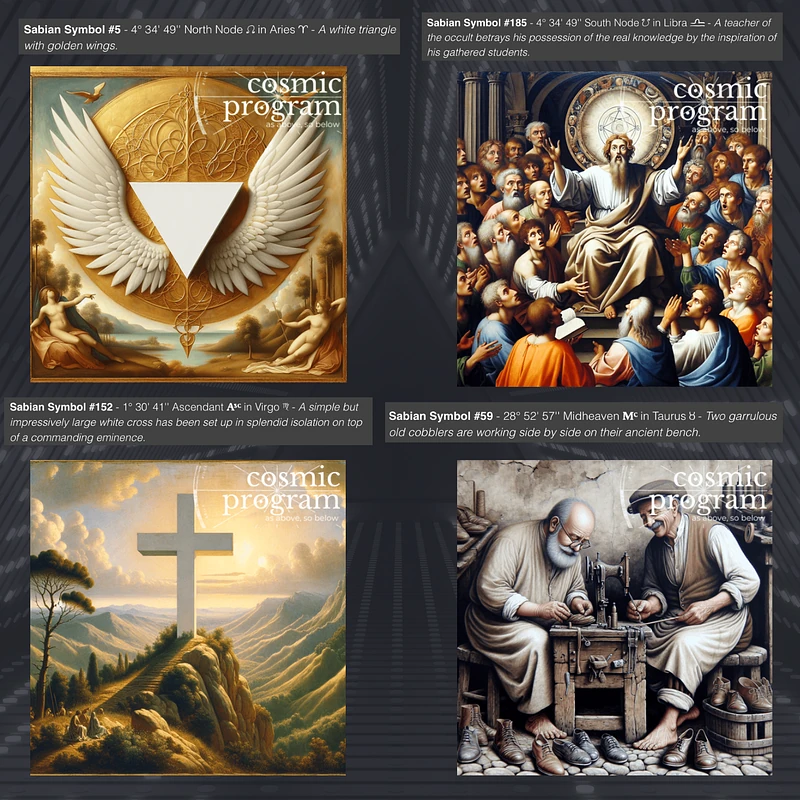
Fig 5. The collection of AI-generated images by Cosmic Program corresponding to the Sabian Symbols for the exact zodiacal degrees associated with the NN (Rahu), SN (Ketu), ASC & MC of the crucifixion horoscope. Refer to the text above each image and the collection in Fig 1 & the link for further analysis.
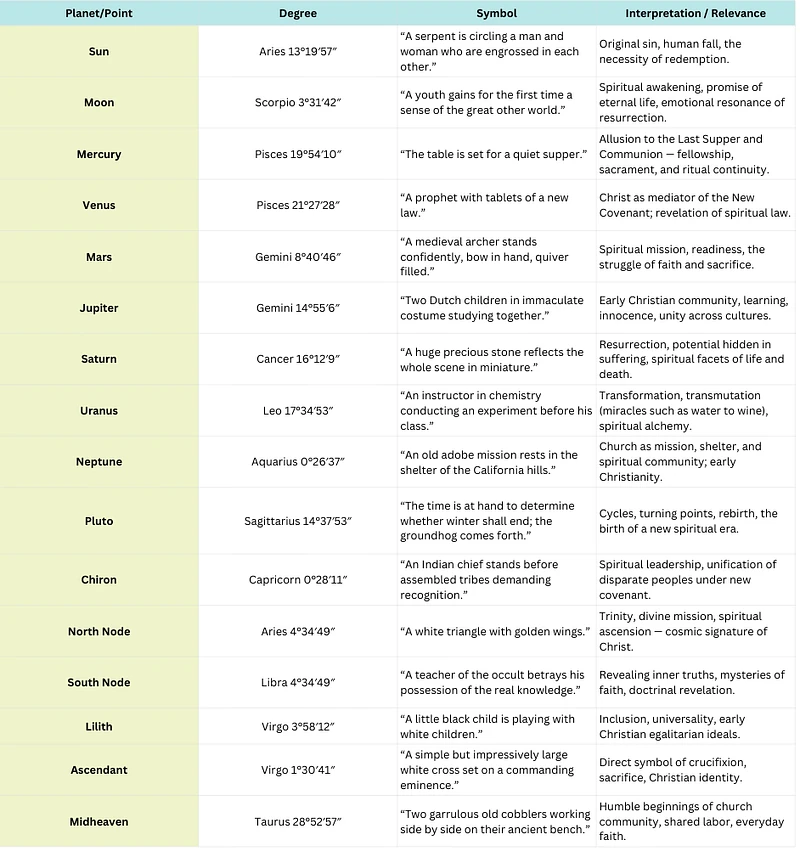
Table 1. Key zodiacal placements in the Crucifixion horoscope, with their corresponding Sabian Symbols, originally divined/remotely viewed for every degree of the zodiac, independent of events and characters, in 1925.
Statistical Analysis: Rarity of the Symbolic Cluster
Each Sabian Symbol represents 1 out of 360 possible degrees (~0.28%). Even using generous criteria, e.g., assuming that roughly 10 out of 360 symbols (≈2.8%) can be classified as “thematically Christian” or strongly resonant with Christian archetypes, the probability of any single planetary point landing on such a symbol is only about 2–3%.
However, the Crucifixion chart displays a 16-point cluster of symbols that align with themes of sacrifice, spiritual transformation, communal destiny, divine law, and redemption. If these placements were independent, an assumption used strictly for statistical illustration, the probability of 16 such thematically coherent hits occurring by chance would be on the order of 10^(-24), an astronomically small likelihood.
To put this into perspective, a probability of 10^(-24) corresponds to 0.000000000000000000000001, approximately one septillionth. This is the same order of improbability as randomly selecting a specific grain of sand from all the beaches on Earth, twice in a row. In statistical terms, events this rare are effectively considered impossible under ordinary chance-based assumptions.
While symbolic systems are not strictly random variables, this rarity suggests that when the Sabian framework is treated as an archetypal language rather than random noise, the Crucifixion horoscope forms a profoundly meaningful cosmic signature, one that resonates unusually well with the central narrative motifs of Christianity.
Synthesis: Archetypal Reading
Taken together, the 16-symbol cluster narrates the full scope of the Christian mythos: Fall & Redemption, Sacrifice & Salvation, Spiritual Revelation & Transformation, Community & Church, Doctrine & Mystery: etc. This symbolic narrative encodes the crucifixion, resurrection, and birth of Christianity as a cosmic pattern.
Perhaps the most important symbolic placement, just as in any horoscope, is the placement/symbol associated with the North Lunar Node, or Rahu. In all ancient traditions, this point represents the soul’s mission, the karmic purpose, or the reason for any birth or incarnation. Remarkably, the symbol for the North Node in this chart is strikingly evocative of the Trinity itself: a white triangle with golden wings (Fig 6). Positioned at the ‘mission’ of the entire fated event, it becomes a powerful emblem, simultaneously invoking the Trinity, Christ’s divine purpose, and the transcendent culmination of the Crucifixion narrative.
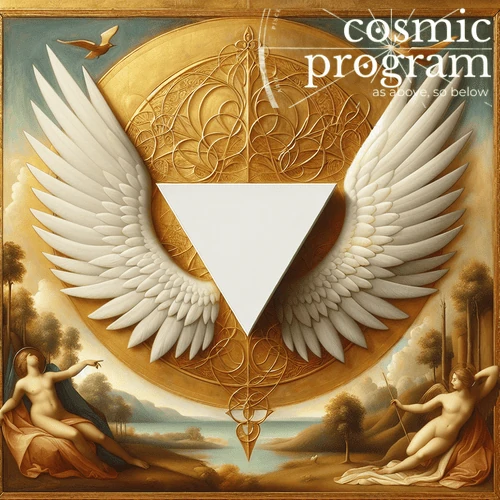
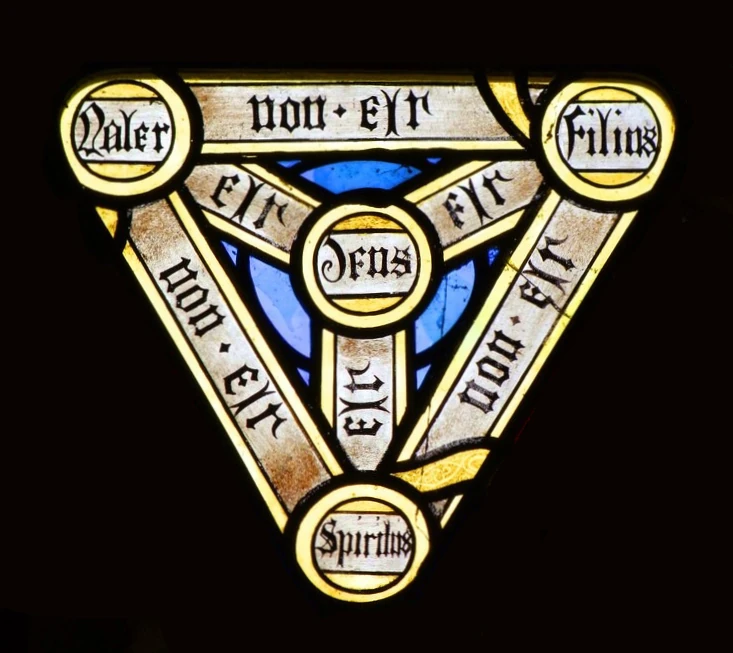
Fig 6: Left: Sabian Symbol #5: The white triangle with golden wings ( by: Cosmic Program). Right: The Holy Trinity on the stained glass windows of the Church of SS Peter and Paul in Brockdish. Source: Unknown, CC BY-SA 2.0 < https://creativecommons.org/licenses/by-sa/2.0 >, via Wikimedia Commons
Conclusion
The Sabian Symbols for the Crucifixion chart, interpreted as archetypal images, outline a coherent cosmic narrative that includes the fall and redemption, the character and mission of Jesus, spiritual agency of Jesus and the subsequent formation of early Christianity.
Each point’s symbolic rarity underscores the improbability of such a cluster occurring randomly, highlighting the potential value of divined symbolism in exploring archetypal patterns across historical events.
At Cosmic Program, we continue to test and validate these symbolic correlations, building a growing body of research for serious, open-minded scientists interested in exploring alternative approaches to understanding reality, including methods and perspectives often considered fringe or prematurely dismissed.
Our aim is to offer a plausible explanation for reality as a simulated, mathematically scripted construct, a matrix entangled with and synchronised to the solar system. We pursue a data-informed framework that explores the mechanisms behind metaphysical and paranormal phenomena that are difficult to dismiss, including remote viewing, astrology, synchronicity, omenology, mediumistic impressions, claircognisance, precognitive dreams, telepathic episodes, and various psychical perceptions.
To conclude, I find it fitting to note that researching and writing this article by someone like me feels almost pre-programmed or destined. The subject matter aligns uncannily with my own horoscope and the unique Sabian Symbols associated with it. As shown in Figure 7, my North Node (Rahu), the indicator of one’s life mission, appears to point toward themes connected to the Cross and Christianity. My Sun’s Sabian Symbol, which reflects vocation, ego, and the sphere in which one is meant to shine, also resonates with distinctly Christian themes.
Remarkably, nearly every symbol in my chart corresponds to traits that form my life’s unmistakable signature, something that continues to reveal itself as more celebrity and historical charts are added to our archive, available for anyone to examine. Our life stories seem not only to correlate with the placements and archetypal nature of planets and asteroids, but also, in striking ways, with the remotely viewed/ divined Sabian Symbols. Taken together, these patterns offer yet another intriguing indication that reality may be less random than assumed, perhaps even simulated or pre-programmed.
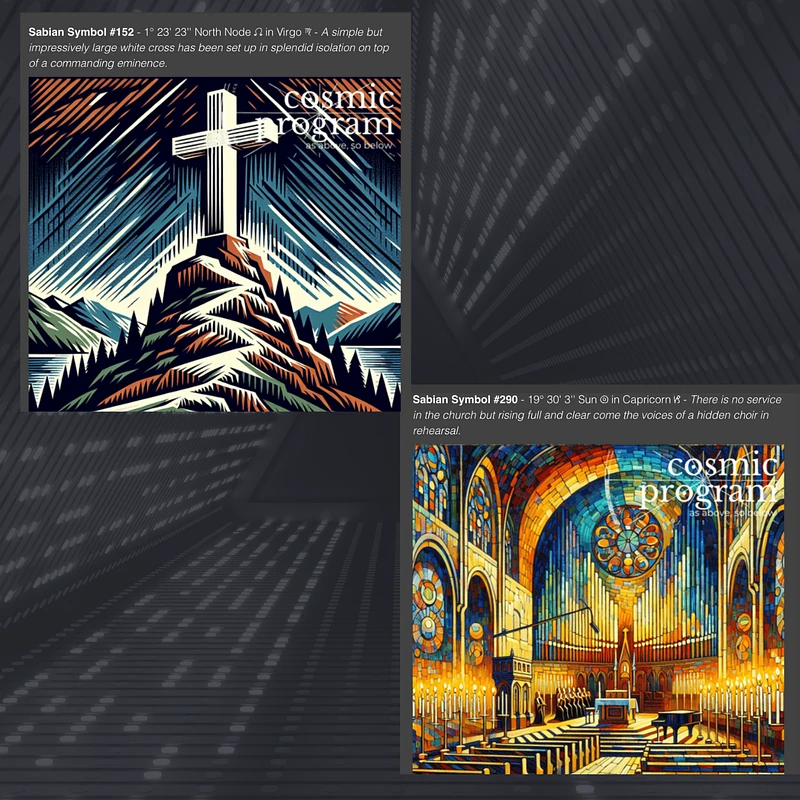
Fig 7: Two of Gaia’s most important Sabian Symbols!
By: Gaia from Cosmic Program
Note: If you’re interested in discovering your unique Sabian Symbols (which tells the story/themes of your life and character)and receiving a personalised PDF featuring your symbols in your choice of ~25 AI-generated art styles, please visit:
References:
5- https://www.cia.gov/readingroom/docs/CIA-RDP96-00791R000200180005-5.pdf
6- https://www.cia.gov/readingroom/search/site/remote%20viewing
7- https://www.cia.gov/readingroom/docs/CIA-RDP96-00789R002800180001-2.pdf
9-https://www.cia.gov/readingroom/document/cia-rdp96-00791r000200070001-9?utm
Appendix
Chat GPT account of Jesus Christ’s Crucifixion Data:
“The most likely date and time of Jesus’ crucifixion, based on historical, biblical, and astronomical evidence, is:
Friday, April 3, 33 CE (Gregorian)
Time of death: Approximately 3:00 PM (15:00), local Jerusalem time.
Reasons for this date:
- Biblical Clues
The Gospels provide several key details:
Jesus was crucified on a Friday, the “Preparation Day” before the Sabbath (Mark 15:42). The crucifixion occurred during Passover, specifically on or near Nisan 14 or 15 in the Hebrew calendar (John 19:14).
Darkness covered the land for three hours, from noon to 3:00 PM (Matthew 27:45).
- Astronomical Evidence
Astronomical reconstructions show that:
Nisan 14 (Passover) in 33 CE fell on a Friday, aligning with the Gospel accounts. A partial lunar eclipse (referred to as the “moon turning to blood” in Acts 2:20 and Joel 2:31) occurred on the evening of April 3, 33 CE, visible from Jerusalem. This could have been interpreted as a significant celestial sign.
- Historical Context
Pontius Pilate was the Roman governor of Judea from 26–36 CE, narrowing the timeframe. The ministry of John the Baptist, referenced as starting in the 15th year of Tiberius Caesar’s reign (Luke 3:1), suggests Jesus began his ministry around 29 CE, which likely lasted about three years. This aligns with a crucifixion in 33 CE.
- Traditional Timing of Death
The Gospels indicate that Jesus died around the ninth hour of the day (using Jewish reckoning, where the day begins at sunrise). This corresponds to 3:00 PM.
By Jewish law, the body had to be buried before sunset to avoid desecrating the Sabbath.
Conclusion:
Given the alignment of biblical descriptions, astronomical data, and historical context, April 3, 33 CE, at approximately 3:00 PM, is the most plausible date and time for the crucifixion of Jesus in the Gregorian calendar.”